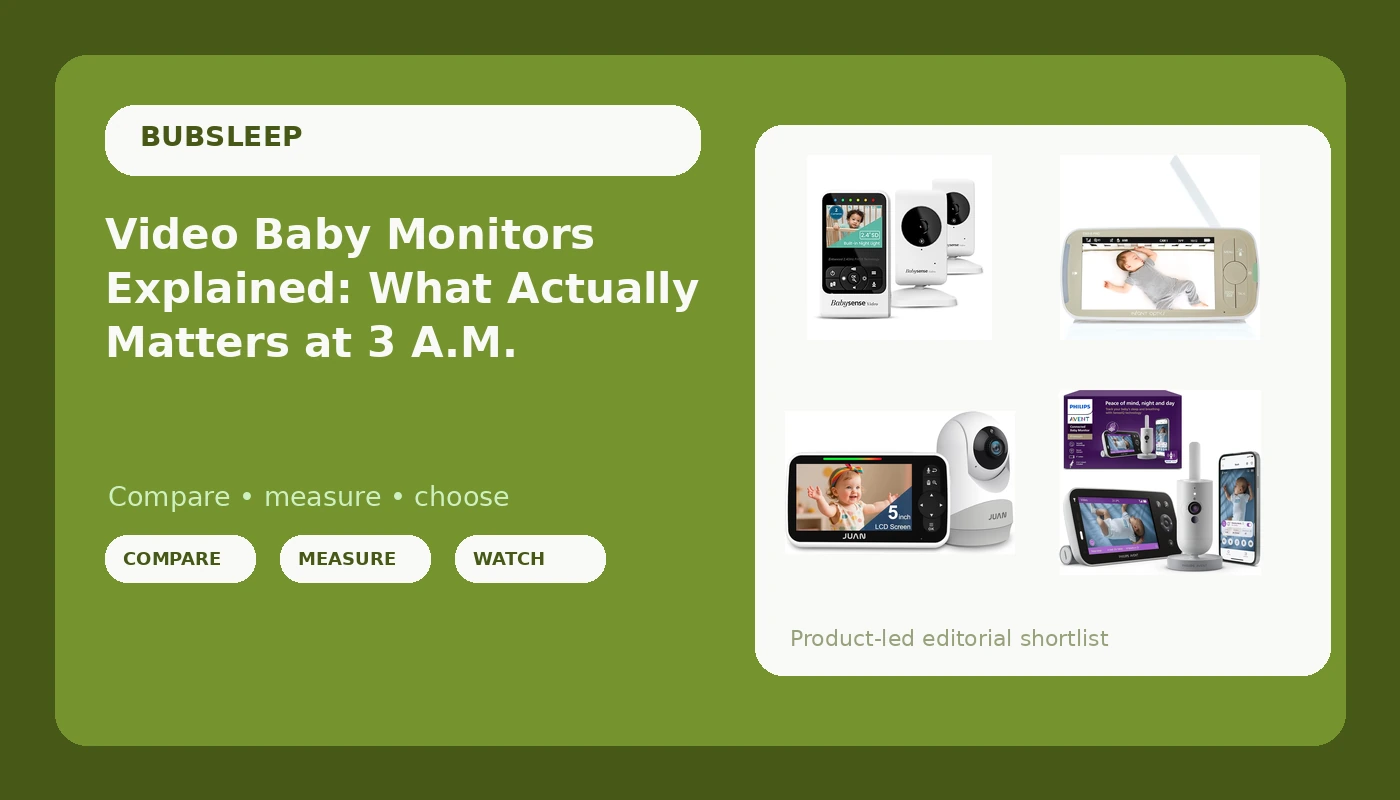
Most parents do not shop for a video baby monitor with a parent unit because they love gadgets. They shop because they want to glance at a screen at 2 a.m. and know, in one second, that their baby is fine. That single moment is what separates a monitor that earns its spot on the nightstand from one that ends up in a drawer by the second week.
The four models here sit at very different points on that spectrum. One is a local radio frequency system that ships with two cameras. One is a connected camera with a 1080p lens and a 5 inch HD screen on the handheld. One is a low cost, no Wi-Fi unit built around privacy rather than features. And one is not a full system at all, but a standalone handheld monitor intended to pair with an Infant Optics DXR-8 PRO you already own.
This explainer covers how these monitors actually move a picture from the crib to your hand, what the spec sheets leave out, and how to choose between them without paying for features you will never touch at 3 a.m.
Related: How to Position a Baby Monitor Camera for Safe Sleep →
Quick answer
There is no single best baby monitor, because the two things that matter most overnight pull in different directions. If you want a dedicated local link with no router involved and more than one camera, the Babysense V24R_2 is the most complete system of the four, since it ships with two cameras and lists infrared night vision, room temperature, two way talk, and built-in sounds. If you want the largest screen and a connected camera, the Philips Avent Premium Connected is the one to look at first. The JUAN is the simplest and least expensive route to a private, Wi-Fi-free camera and audio feed, and the Infant Optics standalone monitor is a replacement or spare handheld for an existing DXR-8 PRO, not a starter kit. Night vision usability, parent unit battery life, and real world range are the three things worth checking before you buy, and none of them can be judged from a spec sheet alone.
Four useful options
| Model | Best fit | What stands out |
|---|---|---|
| Babysense NEW Video Baby Monitor, Model V24R_2 | Watching two rooms from one handheld | Ships with two cameras, infrared night vision, room temperature, two way talk, lullabies and white noise |
| Philips Avent Premium Connected Baby Monitor | Parents who want a big screen and connected features | 1080p camera paired with a 5" HD screen |
| Infant Optics Standalone Monitor for DXR-8 PRO | Existing DXR-8 PRO owners who need a second or replacement handheld | Sold as the monitor alone, no battery included |
| JUAN Baby Monitor with Camera and Audio | A private, Wi-Fi-free setup on a small budget | No Wi-Fi, camera and audio only |
Two cameras, one screen: Babysense NEW Video Baby Monitor
The trade off here is the same one every local RF system makes. You get a dedicated handheld that talks straight to the cameras, and in exchange you give up the app, the cloud clips, and the ability to peek in from a restaurant. For a lot of families that is not a compromise at all, it is the point. A second camera also changes how you use a monitor, because you stop carrying one unit between rooms and start leaving cameras where the sleep actually happens.
Big screen, connected camera: Philips Avent Premium Connected Baby Monitor
Connected cameras solve a real problem, which is seeing your baby from anywhere with a signal instead of anywhere within radio range. The cost is dependency. A Wi-Fi monitor runs on your router, so when the router reboots, or the network gets busy, or the power blips, your view goes with it. That does not make it a bad choice. It makes it a choice you should make deliberately, ideally with a phone that stays charged on the nightstand as a backup view.
A handheld, not a starter kit: Infant Optics Standalone Monitor for DXR-8 PRO
Read the name carefully before you buy. This is the parent unit by itself, and there is no battery in the box, so it is not a complete monitor and it is not a gift for a friend who is still building a registry. It is, however, exactly the right purchase for a specific situation that comes up more often than people expect: the toddler room and the nursery both need a screen, and moving one handheld up and down the stairs every night gets old fast.
No Wi-Fi, low cost: JUAN Baby Monitor with Camera and Audio
The honest framing is that this is a smaller feature set, not a smaller version of the same thing. There is no app, no remote viewing from outside the house, and no cloud anything, which is precisely why some parents pick it. If your goal is a camera in the room and a screen in your hand with nothing else in between, a no-Wi-Fi unit does that job with the fewest moving parts.
Prices and availability may change. Product images, names, and retailer links must be matched by verified ASIN. Do not state a current price, rating, stock status, or measured result without current evidence.
How a monitor actually gets a picture to your hand
Every baby monitor answers the same question with one of two technologies. A local RF monitor, like the Babysense and the JUAN, builds a direct radio link between the camera and the handheld parent unit. Nothing else is in the path. There is no router, no account, and no internet connection, which is why these units tend to come up instantly and keep coming up when your internet does not. The range is limited by the radio and the walls between you and the camera, not by your broadband plan.
A Wi-Fi monitor, like the Philips Avent Premium Connected, sends the video over your home network. That is what makes the app possible: the camera encodes the picture, the router carries it, and your phone or tablet decodes it wherever you have a connection. The upside is remote viewing, a bigger screen than any handheld, and software features that can be updated over time. The downside is that every one of those steps is a potential failure point. When parents say a Wi-Fi monitor "went down," they usually mean the network went down, not the camera.
Neither approach is inherently safer. The safety question is whether you can see your baby clearly and consistently during the hours you are actually asleep, and both technologies can deliver that or fail at it depending on the specific hardware.
What the spec sheet does not tell you
Box copy sells resolution because resolution is easy to print. It is also the least useful number for overnight use. A 1080p feed that is washed out by infrared glare is worse than a lower resolution feed you can read at a glance, so the first thing to look for is whether the monitor lists night vision at all and whether you can find real feedback about how it performs in a fully dark room.
Range is the second number nobody prints honestly. "Long range" is meaningless without knowing whether that means across a hallway or across a two story house with a plaster wall in between. The only meaningful test is the one you run yourself: put the camera where it will live, walk to the kitchen, the basement, and the far end of the yard, and see whether the picture holds.
The parent unit is the third thing spec sheets undersell. You will hold it, drop it, and charge it every day for years, and a monitor with a great camera and a handheld that dies at 4 a.m. is a failed device. Battery life, screen brightness at its lowest setting, and how the unit feels in one hand at 3 a.m. matter more than any camera spec.
- Decide whether you want a local RF link or a Wi-Fi camera, because that single choice eliminates half the market.
- Confirm the monitor lists night vision, and treat any listing that does not as a daytime-only device until proven otherwise.
- Count the rooms you need to watch, and let that decide whether you need a two-camera system or a single camera.
- Check what is actually in the box, including whether a parent unit, a battery, and a power adapter are included.
- Plan the fallback. Whatever you buy, know what you will do if the feed drops at 2 a.m.
Setting up for real nights
- Place the camera so the crib is in frame from the mattress up, not from the ceiling down.
- Keep the camera and its cable at least three feet from the crib, and secure any loose cord out of reach.
- Test the range from the kitchen, the bathroom, and the farthest bedroom before the first night, not after.
- Charge the parent unit every morning so it starts the night full, and keep the charger where you actually sit.
- Run a full dark-room check with the lights off and the curtains closed, since that is the only view that counts.
- If you use a Wi-Fi monitor, make sure your router is on a battery backup or accept that a power blip takes your view with it.
Which option should you choose?
Choose the Babysense NEW Video Baby Monitor, Model V24R_2 when you need two rooms covered from one handheld and you want a local link with no router involved. Choose the Philips Avent Premium Connected Baby Monitor when a 1080p camera and a 5" HD screen matter more to you than working without Wi-Fi. Choose the JUAN Baby Monitor with Camera and Audio when you want the simplest private setup and the smallest spend. Choose the Infant Optics Standalone Monitor for DXR-8 PRO when you already own a DXR-8 PRO and need a second or replacement handheld, and only in that case, since it arrives without a battery and without a camera.
Two caveats are worth stating plainly. First, none of these listings promises a specific night vision distance, battery runtime, or range in feet, so treat any such claim you read elsewhere as unverified until you test it in your own house. Second, a monitor is a convenience device, not a safety device. It does not replace following safe sleep guidance, and no camera angle substitutes for an empty crib with a firm mattress and a baby on their back.
The bottom line
The monitor that works is the one you can see clearly at 3 a.m. and hear from the kitchen. Local RF systems like the Babysense and the JUAN deliver that with the fewest dependencies and no network in the middle, which is why they remain the default for a lot of experienced parents. A connected camera like the Philips Avent Premium Connected buys you a sharper, bigger picture and remote viewing, and asks you to trust your router in return. And the Infant Optics standalone monitor is a smart, narrow purchase for DXR-8 PRO owners who are tired of carrying one handheld between two rooms. Match the technology to your house, verify the night view yourself, and you will stop thinking about the monitor entirely, which is exactly the point.