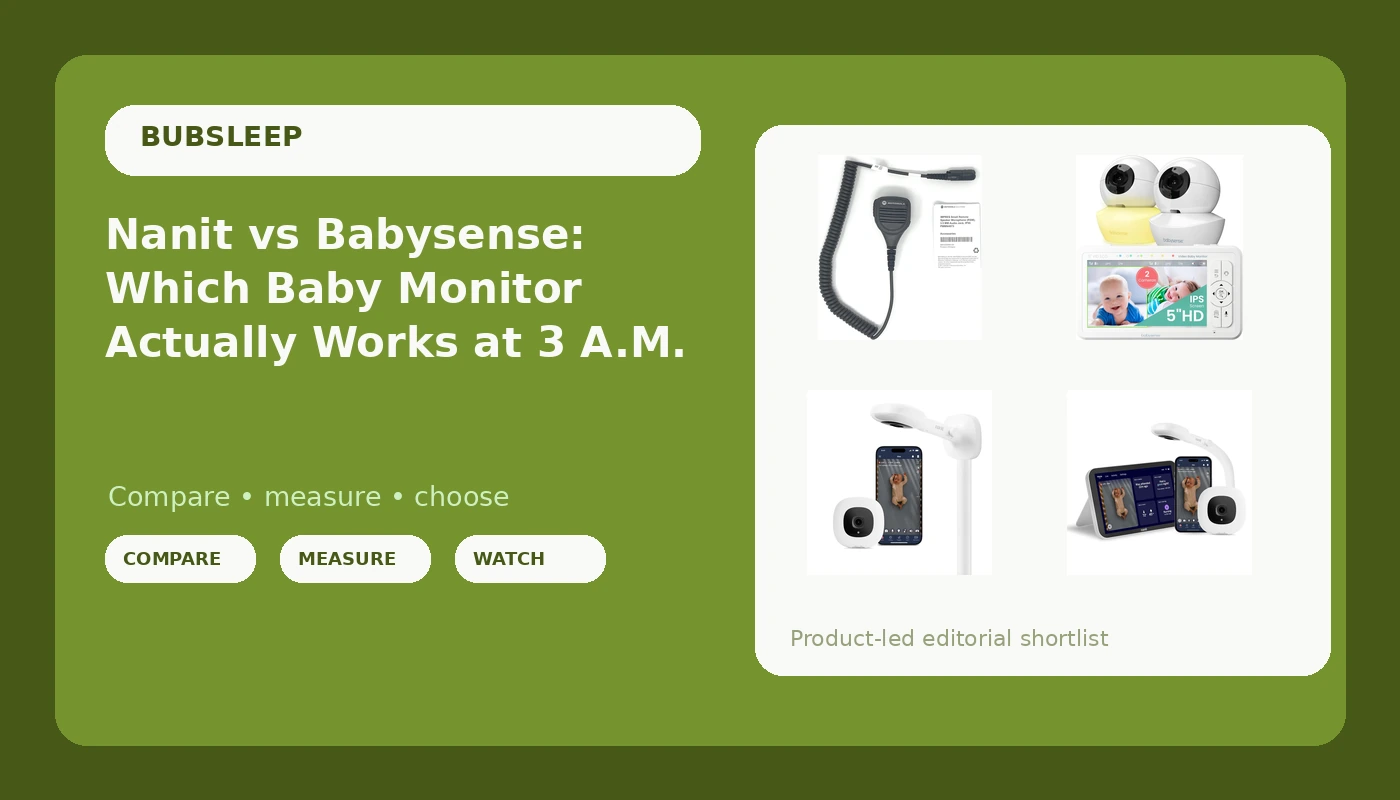
I have been a pediatric nurse for nine years and a mom of two for five of them, which means I have logged more nights watching a baby monitor than I have spent sleeping. My first monitor was the one my registry recommended, a video unit that turned out to be nearly blind in a dark room, and that was the night I started keeping notes on every camera that came through my house. This baby monitor comparison is the version of those notes I would hand to a friend who is eight months pregnant and tired of reading spec sheets.
The short answer: for most families I would buy the Babysense 5" HD Non WiFi Split-Screen, because two cameras, a real parent unit, and no router in the loop covers the 3 a.m. check better than anything else here. The Nanit system with the floor stand is the pick if you want the camera up high and out of a toddler's reach, with an 8" screen parked on the kitchen counter.
One item in this lineup is not a baby monitor at all. I left it in the table because it turns up in the same searches as nursery gear, and anyone who lands on it deserves a straight answer about what it does. More on that below.
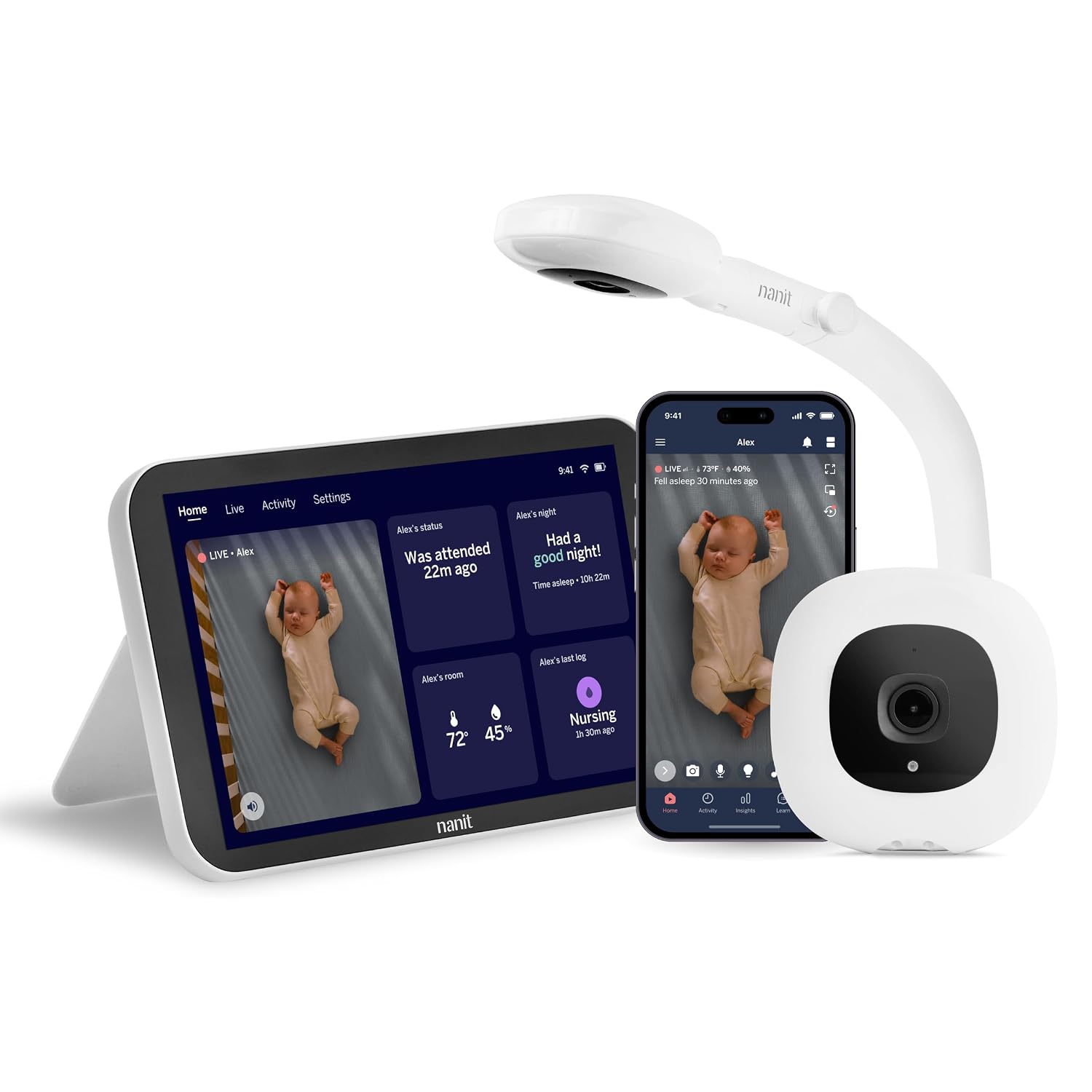
Nanit Smart Baby Video Monitor System with Floor Stand & 8" Display Screen
A floor stand puts the lens above the crib rail and out of a toddler's reach, and the 8" display is a real parent unit, not a phone
Wi-Fi dependent, and the app features that make it "smart" lean on a subscription
Nanit Smart Baby Video Monitor - Camera & Wall Mount - 1080p Wi-Fi Camera
The cleanest install here: 1080p Wi-Fi camera on the wall, no cord draping over a crib, nothing on the floor
No screen in the box, so the parent unit is your phone, which is also your email and your group chat
Babysense 5" HD Non WiFi Split-Screen Baby Monitor, Video Baby Monitor with 2 Cameras and Audio, Night Light, 1000ft Range, Two-Way Audio, 4X Zoom, Night Vision, 4000mAh Battery
Two cameras on one screen, local RF with no buffering, night light, two-way audio, and a 4000mAh parent unit that can run a full night
No phone viewing, a 5" screen, and a picture that will not match a 1080p Wi-Fi feed
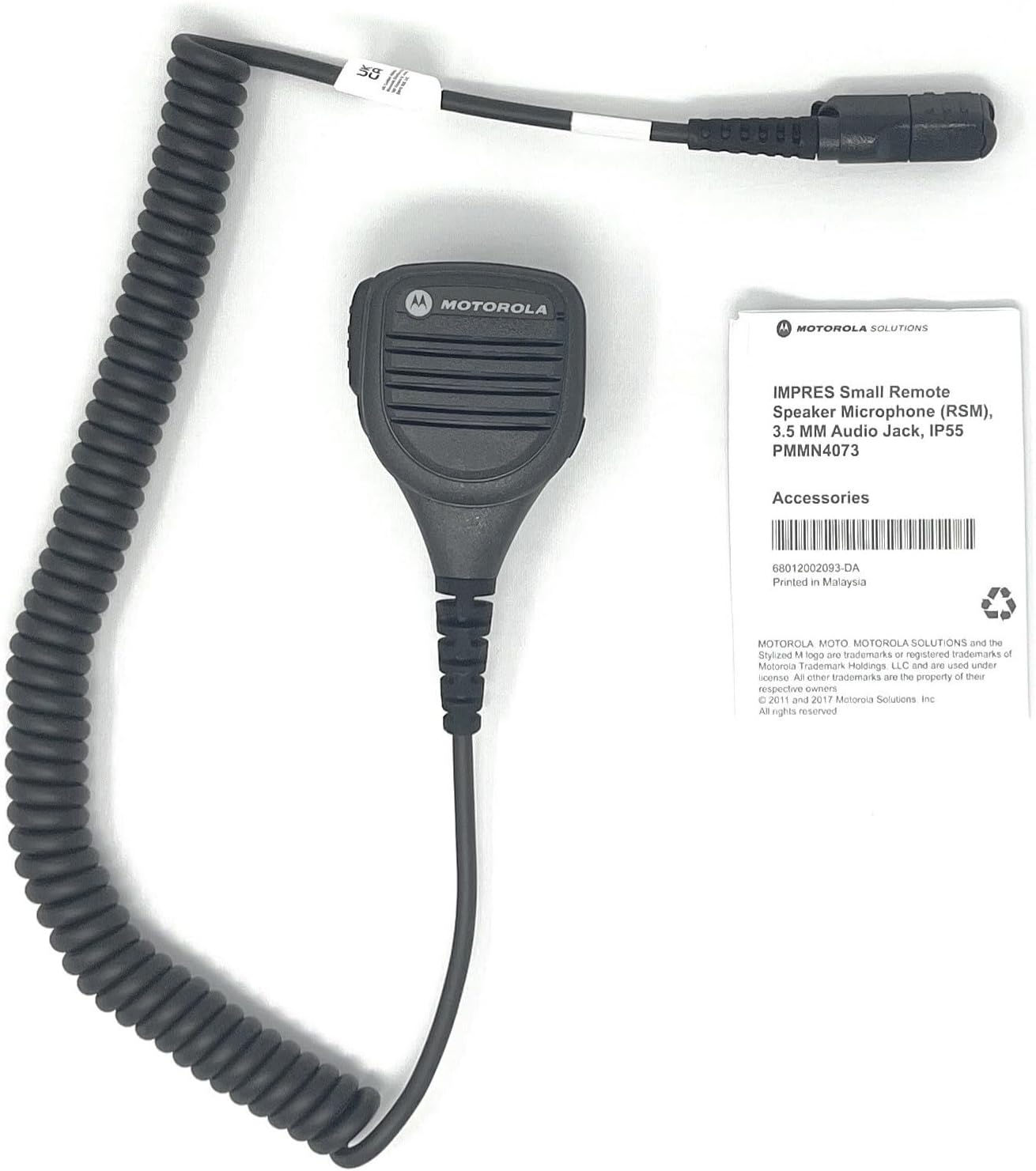
PMMN4073 PMMN4073AL Motorola Original IMPRES Windporting Remote Speaker Microphone
A rugged remote speaker mic for Motorola two-way radios, with windporting that keeps wind noise off your transmit audio
It is not a baby monitor. No camera, no night vision, no parent unit, no crib view
Prices and availability were captured from Amazon Creators API and may change.
How I judge a baby monitor (three tests, all of them at night)
I run every camera through the same three checks, and none of them happen during the day. The first is night vision in a genuinely dark room: curtains closed, lights off, no hallway glow leaking under the door. A monitor that gives me a gray silhouette with no detail has failed, no matter what the box says about resolution. The second is range. I carry the parent unit to the far end of the house, into the kitchen, with the microwave running and the fridge door open, and I watch whether the picture holds. The third is the parent unit itself, unplugged on the nightstand from bedtime until morning. If the screen dies at 2 a.m., the product dies with it. That is not a harsh standard. That is just what a nursery actually looks like.
I do not test monitors in daylight and call it a review. A daytime demo tells you the camera works. It does not tell you whether you will be able to see your baby's chest rise and fall at 3 a.m., which is the only question that matters.
Night vision and range beat resolution every time
Resolution is the spec that sells monitors and the spec that matters least. A sharp feed that drops the moment you walk into the kitchen is a screensaver with anxiety. A modest feed that holds steady across the house is a monitor. I would trade pixels for signal every single time.
Night vision is the feature. If you cannot see your baby at 2 a.m., you are holding a radio, not a monitor. Field of view matters right behind it: 110 degrees is my floor for a standard crib, because anything narrower means you are aiming a camera at a mattress and hoping. Then there is range, the spec nobody prints on the front of the box because it is hard to make impressive. A parent unit that reaches the kitchen, the garage, and the back patio beats a sharper image that stops at the hallway.
Wi-Fi versus local RF: the trade you are actually making
This is the real decision in this comparison, and it has nothing to do with brand.
Wi-Fi monitors like the two Nanit units give you phone access, remote viewing, a 1080p image, and software that can be updated. They also hand your nursery feed to your router, your modem, and your internet provider. When the router hiccups at 2 a.m., the camera is fine and your phone shows you nothing. Local RF monitors like the Babysense keep a direct radio link between camera and parent unit. No account, no app, no buffering, no router drama. When the internet goes down, the Babysense does not notice.
I preach local RF and I still keep a Wi-Fi camera pointed at the crib so I can check on a nap from the backyard. Both things are true. What I will not do is pretend the Wi-Fi path is the reliable one, because it is not. It is the convenient one, and convenience has a failure mode you will meet on the worst possible night.
Nanit Smart Baby Video Monitor System with Floor Stand & 8" Display Screen
This is the version of Nanit that behaves most like a traditional monitor, and it is the one I would point a first-time parent toward if they want the Nanit ecosystem. The camera rides a floor stand, which is the underrated part of the package: it puts the lens above the crib rail instead of at mattress level on a shelf, and it keeps the whole rig out of reach of a toddler who has learned to climb. The 8" display screen is a genuine parent unit, which means you are not waking your phone every time you want to look in. For a parent who wants the Nanit camera but does not want their phone to be the monitor, this is the configuration that solves it.
The trade-off is the same one that follows both Nanit units: the camera is a Wi-Fi camera, and the features that justify the price tag, the sleep tracking and the app-side insights, are the parts that lean on a subscription. You are buying hardware plus an ongoing relationship. Some parents love that. I am the parent who checks the insights and then complains about them, so take that for what it is worth.
Nanit Smart Baby Video Monitor with Camera & Wall Mount
Same camera, different mounting strategy, no screen in the box. The 1080p Wi-Fi camera plus wall mount is the cleanest install in this comparison: the camera goes on the wall above the crib, the cord is managed, and there is nothing on the floor for a toddler to grab or a dog to bump. If you already live on your phone and you want the nursery to look like a nursery instead of a gadget store, this is the version to buy.
What you give up is the parent unit, and that is not a small thing. Your phone becomes the monitor. Your phone is also your email, your group chat, the thing your mother calls at 9 p.m., and the device that dies at 4 a.m. if you forgot to plug it in. I have done the phone-as-parent-unit experiment, and it works until it does not. If you go this route, buy a cheap charging stand for the nightstand and treat it like equipment, because that is what it is now.
Babysense 5" HD Non WiFi Split-Screen Baby Monitor
Two cameras, one 5" screen, and a direct radio link between them. That is the whole pitch, and it is a good one. The split-screen view means a two-kid household can watch both rooms without swapping inputs at 2 a.m. The night light is genuinely useful for middle-of-the-night feeds so you are not flipping a wall switch and waking everyone. Two-way audio lets you talk a toddler back down without walking in and resetting the whole bedtime routine. The 4x zoom gets you from the doorway view to the face. The 4000mAh parent unit is the number that matters most to me, because it is the difference between a monitor that lasts the night and one that beeps at you from the nightstand.
The honest losses: there is no phone app, so you cannot check in from work or from the backyard. The screen is 5", not 8". The image is not going to match a 1080p Wi-Fi feed side by side. And the 1000ft range rating is a number to test in your own house, not a promise, because walls and appliances get a vote. But none of that touches the core job. In my house, the second camera is the one I check first, and a split screen removes a step I do not want to take at 3 a.m.
The Motorola IMPRES windporting speaker microphone is not a baby monitor
Straight answer: this is a remote speaker microphone for Motorola two-way radios. It clips to a shoulder or lapel, the windporting design keeps wind noise out of your transmitted audio, and it is built for job sites, farms, warehouses, and anyone who talks on a radio for a living. There is no camera, no night vision, no parent unit, and no crib view. It cannot tell you whether your baby is breathing, and it will not wake you when your toddler coughs.
If it landed in your cart because it appeared alongside nursery gear, that is a search engine problem, not a product problem. Where it does earn its place is next to a radio: a parent who uses a handheld at work, a family that keeps radios for camping or a large property, or older kids with walkie-talkies who will destroy a phone in a week but cannot kill a shoulder mic. Buy it for that. Do not buy it expecting a monitor.
What each design gives up
Every option here trades something away, and the trade is predictable once you see it.
Wi-Fi buys you remote viewing, a sharper image, and app features. It costs you reliability on the night the router acts up, plus a phone that has to be charged and awake. Local RF buys you a dedicated parent unit that never buffers and never asks for an account. It costs you the ability to check in from anywhere but the room you are standing in. A wall mount buys a clean install and a camera nobody can reach. It costs you flexibility, because moving that camera means patching drywall. A floor stand buys height and portability. It costs you floor space and, if you have a climber, a piece of furniture that needs to be anchored or relocated eventually.
The one thing I will not trade is night vision. Everything else is a preference. That one is a requirement.
Subscription creep and the "smart" part
Here is the unpopular thing I say to every new parent who asks me: if a monitor needs a monthly fee to show you your own baby, you are renting peace of mind. I understand why the app-based features exist. Sleep tracking is interesting, and the sleep insights are the kind of data that makes a tired parent feel like they are doing something measurable. I read them too. But a subscription is a recurring bill attached to a product you already paid for, and it is the first cost people forget when they compare monitors on a spec sheet.
The Babysense has no app and no subscription, because there is nothing to subscribe to. The Nanit units are the opposite: the hardware is the entry point, and the interesting software lives behind a paywall. Neither model is wrong. They just fail differently when money gets tight or when the company changes its mind about what is free.
Which one I would buy
For a first baby in a single nursery, where the goal is the simplest possible 3 a.m. check, I would buy the Babysense 5" HD Non WiFi Split-Screen. It does the core job with no internet in the loop, and the parent unit has the battery to survive the night.
For a parent who wants everything on a phone, wants the camera up on the wall, and does not want a second screen to charge, the Nanit Smart Baby Video Monitor with Camera & Wall Mount is the cleanest version of that idea.
For a parent who wants the Nanit camera but insists on a real parent unit, the Nanit Smart Baby Video Monitor System with Floor Stand & 8" Display Screen is the configuration that makes the ecosystem livable. Just budget for the subscription before you fall in love with the insights.
For two kids in two rooms, the Babysense split-screen ends the input-swapping argument permanently.
And if you arrived here looking for the Motorola IMPRES speaker microphone, it is a fine piece of radio gear and a terrible baby monitor. Those are different jobs, and no product does both.
Whatever you choose, test it before the baby comes. Pitch-dark room, parent unit carried to the kitchen, screen unplugged overnight. If it passes those three, you bought the right one.